Note: if images don't appear please enable "display / load images" in your email program. |
|
“The best advice I ever came across on the subject of concentration is: Wherever you are, be there." |
|
|
|
|---|
|
|
Greetings,
Welcome to this week's Advisor Training newsletter #473. Our goal is to provide training, education and insights for those who adhere to our counter-cultural and sometimes counter-intuitive investment and business philosophy.
Ps. I wish you and your family a fun and relaxing Thanksgiving! |
|
|---|
|
|
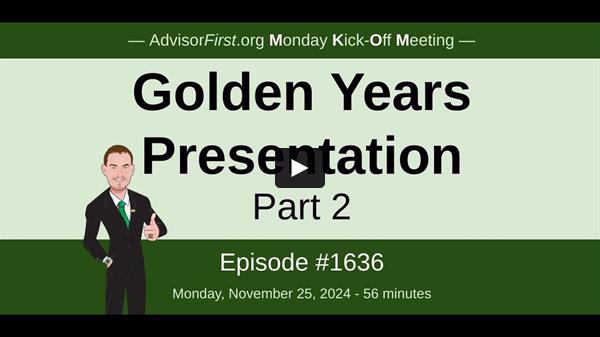
- Main event: Golden Years Presentation, part 2. For more details visit PDF: https://gold.clientfirst.pro
-
17 Tips that Guarantee Success #5: 50-50-50
-
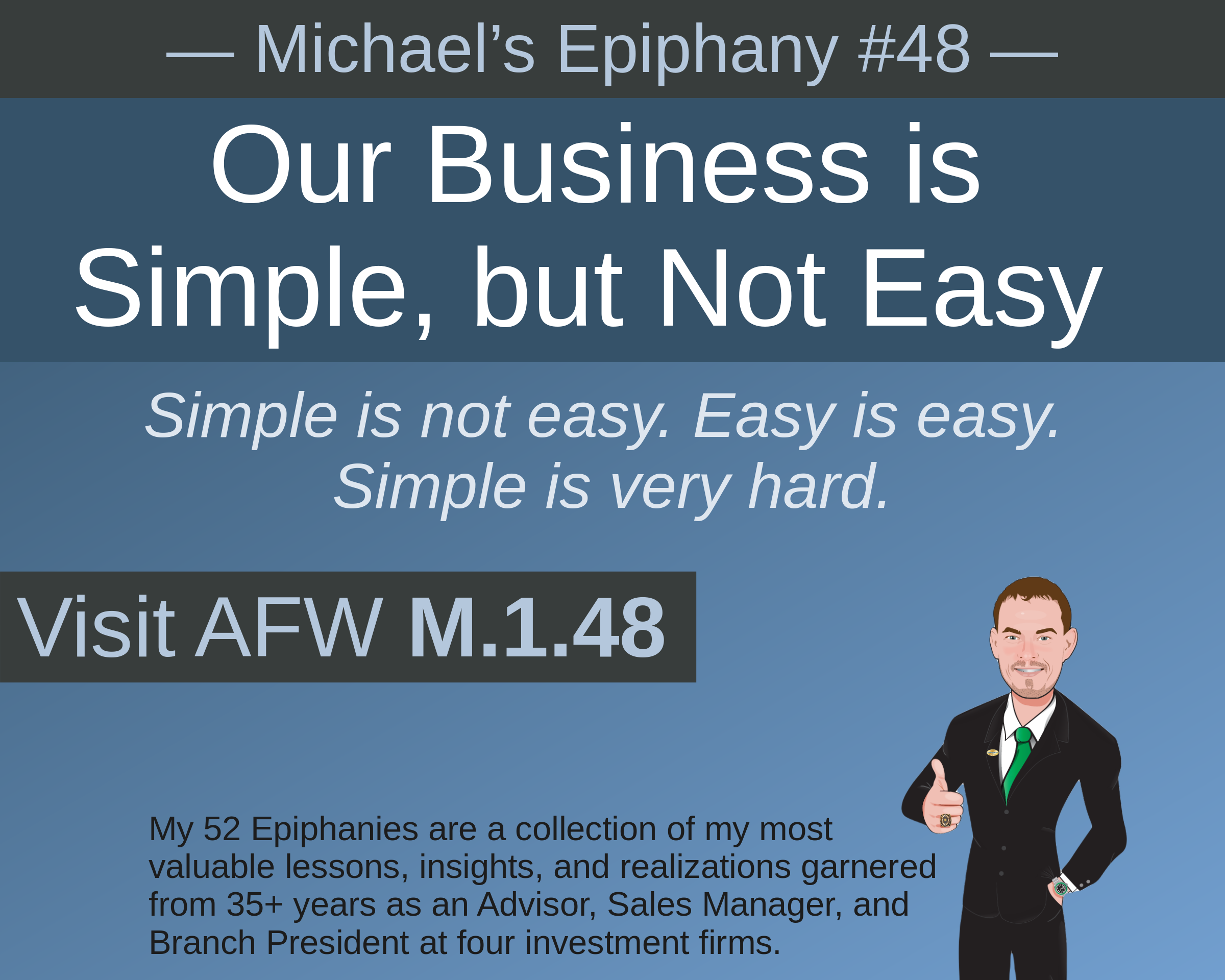
Brief summary of Epiphany #48: Our Business is Simple, but Not Easy.
-
Review of last week's quiz
-
Updates, News and Announcements
-
and much more...
|
|
|---|
|
|
"Having worked at one of the major financial institutions for over a decade, I’ve followed the firm’s investment committee models. I’ve presented these models to clients, aligning their investments with comprehensive financial plans to achieve their required returns with minimal risk.
However, I’ve come to believe that the firm’s equity allocations (ranging from the mid-teens to a maximum of 65%) are more conservative than my clients really need them to be. I've therefore looking to transition our clients to a philosophy more aligned with Nick Murray's: owning diversified portfolios of high-quality companies for the long term rather than being a lender.
My challenge is how to approach this transition with long-standing clients who have been accustomed to my firm’s conservative allocation models.
How should I tee-up those conversations with clients given this change in our investment philosophy?"
|
|
|---|
|
You raise not just an interesting but an important question, and you’re to be commended fo thinking deeply about what’s best for your clients long-term, rather than defaulting to the convenient status quo.
I’d just start by laying out the truth as you see it, in as simple and unvarnished a way as you can. No statistics, no attempt to demonstrate how or why quality equities are better in the long run. Just the quiet statement that you’ve come to believe that they are better, even as you acknowledge their temporary declines — a point you must immediately make.
You’re more likely to get the tone right if you think of what you’re writing as a friendly letter rather than as a financial statement of some kind. I’d probably say something along the lines of:
Dear (name), I hope you know that I'am constantly in the process of thinking about what’s best for my clients. I continually ask myself: am I confident that the plans and solutions I’ve recommended are optimal, or might there be potential improvements I should bring to their attention?
After a considerable amount of study, I’ve concluded that many and perhaps most of my clients might be better served in the long run by increasing their exposure to a diversified portfolio of the world's great, publicly-traded, mainstream, enduringly successful companies. Becoming stockholders has historically produced significantly greater long-term returns net of inflation than has lending to those kinds of companies (that is, being bondholders).
In the next breath, of course, stockholders have historically experienced much larger (though temporary) price declines from time to time.
I’ve gradually arrived at the conclusion that for genuinely long-term investors seeking growth of both their capital and (through historically increasing dividends) their income, the potential reward of owning broadly diversified portfolios of superior companies considerably outweighs the risks. This is the conversation I’d like to begin having with you. |
|
|---|
|
#11 ― AdvisorFirst Dailies Telegram Chatroom |
|
|---|
|
This chatroom is open to
all Advisors, even those not part of AdvisorFirst. I strongly encourage you join it and check it daily - it will give a good insight into our philosophies and training. |
|
|---|
|
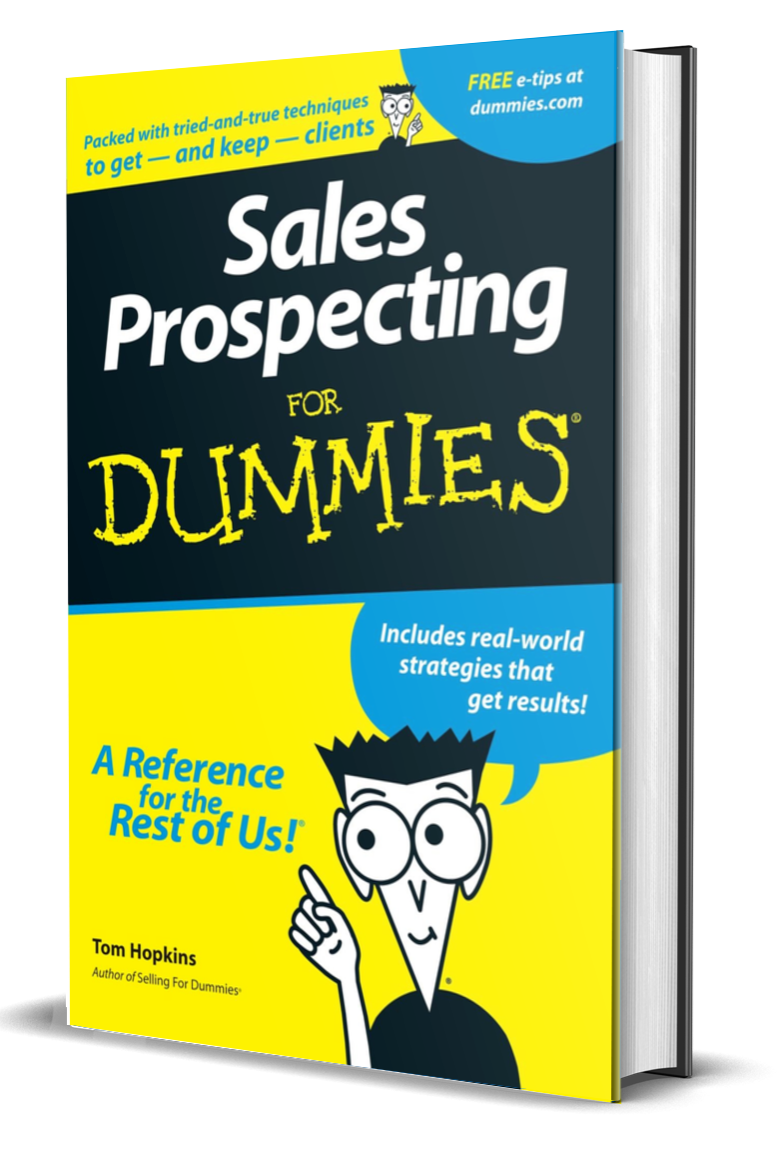
Prospecting ― finding and qualifying prospective clients ― is the first step in the selling proposition.
By Tom Hopkins |
|
|
|
|
“How do you define 'what’s right' for your clients? Easy. Ask yourself, 'Knowing what I know, what would I do for myself?''
Do that.” |
|
|
|
|---|
|
Clients
Our broker/dealer (IP) is 'agnostic' when it comes to investment philosophy and products. They leave it up to us to craft the best strategy for our clients (as long as it is compliant and suitable). IP doesn't have an 'agenda'. You want to do all-equity, A-share, mutual funds a la Nick Murray? Fine. Or a more traditional 80/20 split via fee-based? It's your choice.
However, as a Team (AdvisorFirst) we
do have a belief system and we
do think there are right ways and wrong ways of doing things. Though we will never prohibit you from writing particular products and methods of generating revenue, we will do our utmost to help you do the
best for your clients.
- IP doesn't charge extra fees to clients, such as ticket charges on B/D accounts.
- IP Advisory doesn't charge extra fees on fee-based accounts. Many firms charge an additional fee purely for profit (my previous B/D added an
extra 0.15% fee - you guessed, for pure profit!).
- IP also allows you to lower your Advisory fee down to 0.1%, if you need to be competitive.
- IP doesn't 'create' their own proprietary products and promote it to the salesforce. My former B/D did this twice (you can guess why).
Advisor Fees
- IP has given our Team an
exclusive discount of $750 on startup/transfer fees! That means the total start-up cost (not including exam/study fees) is
less than $200 (depending upon the states a rep adds).
- For those starting brand-new in the industry and getting licensed, IP will reimburse them 20% of your Kaplan study material after they've written their first securities sale. This discount is exclusive to our group.
- The monthly fees are $140. This
includes E&O! IP has one of the lowest cost Errors and Omissions (E&O) Insurance that covers life insurance, securities
and RIA business. These are
very low and reduces the barrier to entry. Compare that to Px's $470+ per month.
- If you want a FINRA branch, the annual cost is only $200.
- Visit our licensing fees calculator.
- Note: for life-only reps the E&O is $50 / month. No start-up costs. Yes, we can hire life-only reps, who may or may not continue to get securities licensed.
Client/Product Fees
- Flat platform custodian fees are
all inclusive – no ticket charges.
- No Advisory tack-on fee, such as Px's 0.15%. For fee-based accounts there is only the management fee (ie, Capital Group), the platform fee (ie, Schwab, Evestnet etc), and the Advisor fee, which you decide what to charge (you can go as low as 0.25%).
- IP doesn't use our Advisor monthly fees as a profit center (most B/D's do). They charge us exactly what the wholesale cost of E&O and the technology packages are. That is why are fees are only $185/m which includes E&O for life insurance. broker/dealer
and Advisory, and includes LaserApp (which cost between $35 - $75/m).
- IP treats Advisors as humans not revenue-producing-machines. Any decisions they make consider us as a
person. They don't change the system on us every 12 - 24 months, they won't steal from us, nor make empty promises (all things I've experienced at previous B/Ds).
|
|
|---|
|
Under which circumstances are qualified retirement plan distributions likely to receive a tax penalty? |
|
|---|
|
- Late distributions only.
- Pre-mature distributions only.
- Both early and late distributions.
- If your AGI is over $250,000.
- Only if the distributions are used for non-retirement purposes.
- Never.
|
|
|---|
|
Answer = 3
Both early and late distributions. |
|
|---|
|
Michael Paulding Thomas
Securities Principal & Advisor Development
Over three decades of training part-time and full-time financial advisors. Developed 2 $200k-earners, 10 $100k-earners, 15 part-time $50k-earners and built a $1.6M revenue sales force.
|
|
|
|
|
|
| |
|
|